

Accurate & Verified 2026 New Databricks-Generative-AI-Engineer-Associate Answers As Experienced in the Actual Test!
Databricks-Generative-AI-Engineer-Associate Certification Sample Questions certification Exam
Databricks Databricks-Generative-AI-Engineer-Associate Exam Syllabus Topics:
| Topic | Details |
|---|---|
| Topic 1 |
|
| Topic 2 |
|
| Topic 3 |
|
NEW QUESTION # 24
A small and cost-conscious startup in the cancer research field wants to build a RAG application using Foundation Model APIs.
Which strategy would allow the startup to build a good-quality RAG application while being cost-conscious and able to cater to customer needs?
- A. Limit the number of queries a customer can send per day
- B. Use the largest LLM possible because that gives the best performance for any general queries
- C. Limit the number of relevant documents available for the RAG application to retrieve from
- D. Pick a smaller LLM that is domain-specific
Answer: D
Explanation:
For a small, cost-conscious startup in the cancer research field, choosing a domain-specific and smaller LLM is the most effective strategy. Here's whyBis the best choice:
* Domain-specific performance: A smaller LLM that has been fine-tuned for the domain of cancer research will outperform a general-purpose LLM for specialized queries. This ensures high-quality responses without needing to rely on a large, expensive LLM.
* Cost-efficiency: Smaller models are cheaper to run, both in terms of compute resources and API usage costs. A domain-specific smaller LLM can deliver good quality responses without the need for the extensive computational power required by larger models.
* Focused knowledge: In a specialized field like cancer research, having an LLM tailored to the subject matter provides better relevance and accuracy for queries, while keeping costs low.Large, general- purpose LLMs may provide irrelevant information, leading to inefficiency and higher costs.
This approach allows the startup to balance quality, cost, and customer satisfaction effectively, making it the most suitable strategy.
NEW QUESTION # 25
A Generative Al Engineer would like an LLM to generate formatted JSON from emails. This will require parsing and extracting the following information: order ID, date, and sender email. Here's a sample email: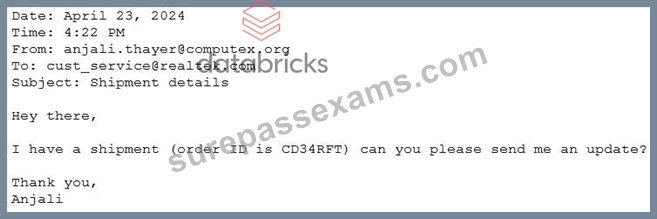
They will need to write a prompt that will extract the relevant information in JSON format with the highest level of output accuracy.
Which prompt will do that?
- A. You will receive customer emails and need to extract date, sender email, and order ID. Return the extracted information in JSON format.
Here's an example: {"date": "April 16, 2024", "sender_email": "[email protected]", "order_id":
"RE987D"} - B. You will receive customer emails and need to extract date, sender email, and order ID. You should return the date, sender email, and order ID information in JSON format.
- C. You will receive customer emails and need to extract date, sender email, and order ID. Return the extracted information in JSON format.
- D. You will receive customer emails and need to extract date, sender email, and order ID. Return the extracted information in a human-readable format.
Answer: A
Explanation:
Problem Context: The goal is to parse emails to extract certain pieces of information and output this in a structured JSON format. Clarity and specificity in the prompt design will ensure higher accuracy in the LLM' s responses.
Explanation of Options:
* Option A: Provides a general guideline but lacks an example, which helps an LLM understand the exact format expected.
* Option B: Includes a clear instruction and a specific example of the output format. Providing an example is crucial as it helps set the pattern and format in which the information should be structured, leading to more accurate results.
* Option C: Does not specify that the output should be in JSON format, thus not meeting the requirement.
* Option D: While it correctly asks for JSON format, it lacks an example that would guide the LLM on how to structure the JSON correctly.
Therefore,Option Bis optimal as it not only specifies the required format but also illustrates it with an example, enhancing the likelihood of accurate extraction and formatting by the LLM.
NEW QUESTION # 26
A Generative Al Engineer has developed an LLM application to answer questions about internal company policies. The Generative AI Engineer must ensure that the application doesn't hallucinate or leak confidential data.
Which approach should NOT be used to mitigate hallucination or confidential data leakage?
- A. Add guardrails to filter outputs from the LLM before it is shown to the user
- B. Use a strong system prompt to ensure the model aligns with your needs.
- C. Fine-tune the model on your data, hoping it will learn what is appropriate and not
- D. Limit the data available based on the user's access level
Answer: C
Explanation:
When addressing concerns of hallucination and data leakage in an LLM application for internal company policies, fine-tuning the model on internal data with the hope it learns data boundaries can be problematic:
* Risk of Data Leakage: Fine-tuning on sensitive or confidential data does not guarantee that the model will not inadvertently include or reference this data in its outputs. There's a risk of overfitting to the specific data details, which might lead to unintended leakage.
* Hallucination: Fine-tuning does not necessarily mitigate the model's tendency to hallucinate; in fact, it might exacerbate it if the training data is not comprehensive or representative of all potential queries.
Better Approaches:
* A,C, andDinvolve setting up operational safeguards and constraints that directly address data leakage and ensure responses are aligned with specific user needs and security levels.
Fine-tuning lacks the targeted control needed for such sensitive applications and can introduce new risks, making it an unsuitable approach in this context.
NEW QUESTION # 27
A Generative Al Engineer is tasked with improving the RAG quality by addressing its inflammatory outputs.
Which action would be most effective in mitigating the problem of offensive text outputs?
- A. Curate upstream data properly that includes manual review before it is fed into the RAG system
- B. Inform the user of the expected RAG behavior
- C. Increase the frequency of upstream data updates
- D. Restrict access to the data sources to a limited number of users
Answer: A
Explanation:
Addressing offensive or inflammatory outputs in a Retrieval-Augmented Generation (RAG) system is critical for improving user experience and ensuring ethical AI deployment. Here's whyDis the most effective approach:
* Manual data curation: The root cause of offensive outputs often comes from the underlying data used to train the model or populate the retrieval system. By manually curating the upstream data and conducting thorough reviews before the data is fed into the RAG system, the engineer can filter out harmful, offensive, or inappropriate content.
* Improving data quality: Curating data ensures the system retrieves and generates responses from a high-quality, well-vetted dataset. This directly impacts the relevance and appropriateness of the outputs from the RAG system, preventing inflammatory content from being included in responses.
* Effectiveness: This strategy directly tackles the problem at its source (the data) rather than just mitigating the consequences (such as informing users or restricting access). It ensures that the system consistently provides non-offensive, relevant information.
Other options, such as increasing the frequency of data updates or informing users about behavior expectations, may not directly mitigate the generation of inflammatory outputs.
NEW QUESTION # 28
A Generative AI Engineer is building an LLM to generate article summaries in the form of a type of poem, such as a haiku, given the article content. However, the initial output from the LLM does not match the desired tone or style.
Which approach will NOT improve the LLM's response to achieve the desired response?
- A. Fine-tune the LLM on a dataset of desired tone and style
- B. Provide the LLM with a prompt that explicitly instructs it to generate text in the desired tone and style
- C. Use a neutralizer to normalize the tone and style of the underlying documents
- D. Include few-shot examples in the prompt to the LLM
Answer: C
Explanation:
The task at hand is to improve the LLM's ability to generate poem-like article summaries with the desired tone and style. Using aneutralizerto normalize the tone and style of the underlying documents (option B) will not help improve the LLM's ability to generate the desired poetic style. Here's why:
* Neutralizing Underlying Documents:A neutralizer aims to reduce or standardize the tone of input data. However, this contradicts the goal, which is to generate text with aspecific tone and style(like haikus). Neutralizing the source documents will strip away the richness of the content, making it harder for the LLM to generate creative, stylistic outputs like poems.
* Why Other Options Improve Results:
* A (Explicit Instructions in the Prompt): Directly instructing the LLM to generate text in a specific tone and style helps align the output with the desired format (e.g., haikus). This is a common and effective technique in prompt engineering.
* C (Few-shot Examples): Providing examples of the desired output format helps the LLM understand the expected tone and structure, making it easier to generate similar outputs.
* D (Fine-tuning the LLM): Fine-tuning the model on a dataset that contains examples of the desired tone and style is a powerful way to improve the model's ability to generate outputs that match the target format.
Therefore, using a neutralizer (option B) isnotan effective method for achieving the goal of generating stylized poetic summaries.
NEW QUESTION # 29
A Generative Al Engineer is creating an LLM system that will retrieve news articles from the year 1918 and related to a user's query and summarize them. The engineer has noticed that the summaries are generated well but often also include an explanation of how the summary was generated, which is undesirable.
Which change could the Generative Al Engineer perform to mitigate this issue?
- A. Revisit their document ingestion logic, ensuring that the news articles are being ingested properly.
- B. Provide few shot examples of desired output format to the system and/or user prompt.
- C. Tune the chunk size of news articles or experiment with different embedding models.
- D. Split the LLM output by newline characters to truncate away the summarization explanation.
Answer: B
Explanation:
To mitigate the issue of the LLM including explanations of how summaries are generated in its output, the best approach is to adjust the training or prompt structure. Here's why Option D is effective:
* Few-shot Learning: By providing specific examples of how the desired output should look (i.e., just the summary without explanation), the model learns the preferred format. This few-shot learning approach helps the model understand not only what content to generate but also how to format its responses.
* Prompt Engineering: Adjusting the user prompt to specify the desired output format clearly can guide the LLM to produce summaries without additional explanatory text. Effective prompt design is crucial in controlling the behavior of generative models.
Why Other Options Are Less Suitable:
* A: While technically feasible, splitting the output by newline and truncating could lead to loss of important content or create awkward breaks in the summary.
* B: Tuning chunk sizes or changing embedding models does not directly address the issue of the model's tendency to generate explanations along with summaries.
* C: Revisiting document ingestion logic ensures accurate source data but does not influence how the model formats its output.
By using few-shot examples and refining the prompt, the engineer directly influences the output format, making this approach the most targeted and effective solution.
NEW QUESTION # 30
A Generative Al Engineer is setting up a Databricks Vector Search that will lookup news articles by topic within 10 days of the date specified An example query might be "Tell me about monster truck news around January 5th 1992". They want to do this with the least amount of effort.
How can they set up their Vector Search index to support this use case?
- A. Split articles by 10 day blocks and return the block closest to the query.
- B. pass the query directly to the vector search index and return the best articles.
- C. Create separate indexes by topic and add a classifier model to appropriately pick the best index.
- D. Include metadata columns for article date and topic to support metadata filtering.
Answer: D
Explanation:
The task is to set up a Databricks Vector Search index for news articles, supporting queries like "monster truck news around January 5th, 1992," with minimal effort. The index must filter by topic and a 10-day date range. Let's evaluate the options.
* Option A: Split articles by 10-day blocks and return the block closest to the query
* Pre-splitting articles into 10-day blocks requires significant preprocessing and index management (e.g., one index per block). It's effort-intensive and inflexible for dynamic date ranges.
* Databricks Reference:"Static partitioning increases setup complexity; metadata filtering is preferred"("Databricks Vector Search Documentation").
* Option B: Include metadata columns for article date and topic to support metadata filtering
* Adding date and topic as metadata in the Vector Search index allows dynamic filtering (e.g., date
± 5 days, topic = "monster truck") at query time. This leverages Databricks' built-in metadata filtering, minimizing setup effort.
* Databricks Reference:"Vector Search supports metadata filtering on columns like date or category for precise retrieval with minimal preprocessing"("Vector Search Guide," 2023).
* Option C: Pass the query directly to the vector search index and return the best articles
* Passing the full query (e.g., "Tell me about monster truck news around January 5th, 1992") to Vector Search relies solely on embeddings, ignoring structured filtering for date and topic. This risks inaccurate results without explicit range logic.
* Databricks Reference:"Pure vector similarity may not handle temporal or categorical constraints effectively"("Building LLM Applications with Databricks").
* Option D: Create separate indexes by topic and add a classifier model to appropriately pick the best index
* Separate indexes per topic plus a classifier model adds significant complexity (index creation, model training, maintenance), far exceeding "least effort." It's overkill for this use case.
* Databricks Reference:"Multiple indexes increase overhead; single-index with metadata is simpler"("Databricks Vector Search Documentation").
Conclusion: Option B is the simplest and most effective solution, using metadata filtering in a single Vector Search index to handle date ranges and topics, aligning with Databricks' emphasis on efficient, low-effort setups.
NEW QUESTION # 31
What is an effective method to preprocess prompts using custom code before sending them to an LLM?
- A. Rather than preprocessing prompts, it's more effective to postprocess the LLM outputs to align the outputs to desired outcomes
- B. It is better not to introduce custom code to preprocess prompts as the LLM has not been trained with examples of the preprocessed prompts
- C. Write a MLflow PyFunc model that has a separate function to process the prompts
- D. Directly modify the LLM's internal architecture to include preprocessing steps
Answer: C
Explanation:
The most effective way to preprocess prompts using custom code is to write a custom model, such as an MLflow PyFunc model. Here's a breakdown of why this is the correct approach:
* MLflow PyFunc Models:MLflow is a widely used platform for managing the machine learning lifecycle, including experimentation, reproducibility, and deployment. APyFuncmodel is a generic Python function model that can implement custom logic, which includes preprocessing prompts.
* Preprocessing Prompts:Preprocessing could include various tasks like cleaning up the user input, formatting it according to specific rules, or augmenting it with additional context before passing it to the LLM. Writing this preprocessing as part of a PyFunc model allows the custom code to be managed, tested, and deployed easily.
* Modular and Reusable:By separating the preprocessing logic into a PyFunc model, the system becomes modular, making it easier to maintain and update without needing to modify the core LLM or retrain it.
* Why Other Options Are Less Suitable:
* A (Modify LLM's Internal Architecture): Directly modifying the LLM's architecture is highly impractical and can disrupt the model's performance. LLMs are typically treated as black-box models for tasks like prompt processing.
* B (Avoid Custom Code): While it's true that LLMs haven't been explicitly trained with preprocessed prompts, preprocessing can still improve clarity and alignment with desired input formats without confusing the model.
* C (Postprocessing Outputs): While postprocessing the output can be useful, it doesn't address the need for clean and well-formatted inputs, which directly affect the quality of the model's responses.
Thus, using an MLflow PyFunc model allows for flexible and controlled preprocessing of prompts in a scalable way, making it the most effective method.
NEW QUESTION # 32
A Generative AI Engineer is designing an LLM-powered live sports commentary platform. The platform provides real-time updates and LLM-generated analyses for any users who would like to have live summaries, rather than reading a series of potentially outdated news articles.
Which tool below will give the platform access to real-time data for generating game analyses based on the latest game scores?
- A. AutoML
- B. DatabrickslQ
- C. Feature Serving
- D. Foundation Model APIs
Answer: C
Explanation:
* Problem Context: The engineer is developing an LLM-powered live sports commentary platform that needs to provide real-time updates and analyses based on the latest game scores. The critical requirement here is the capability to access and integrate real-time data efficiently with the platform for immediate analysis and reporting.
* Explanation of Options:
* Option A: DatabricksIQ: While DatabricksIQ offers integration and data processing capabilities, it is more aligned with data analytics rather than real-time feature serving, which is crucial for immediate updates necessary in a live sports commentary context.
* Option B: Foundation Model APIs: These APIs facilitate interactions with pre-trained models and could be part of the solution, but on their own, they do not provide mechanisms to access real- time game scores.
* Option C: Feature Serving: This is the correct answer as feature serving specifically refers to the real-time provision of data (features) to models for prediction. This would be essential for an LLM that generates analyses based on live game data, ensuring that the commentary is current and based on the latest events in the sport.
* Option D: AutoML: This tool automates the process of applying machine learning models to real-world problems, but it does not directly provide real-time data access, which is a critical requirement for the platform.
Thus,Option C(Feature Serving) is the most suitable tool for the platform as it directly supports the real-time data needs of an LLM-powered sports commentary system, ensuring that the analyses and updates are based on the latest available information.
NEW QUESTION # 33
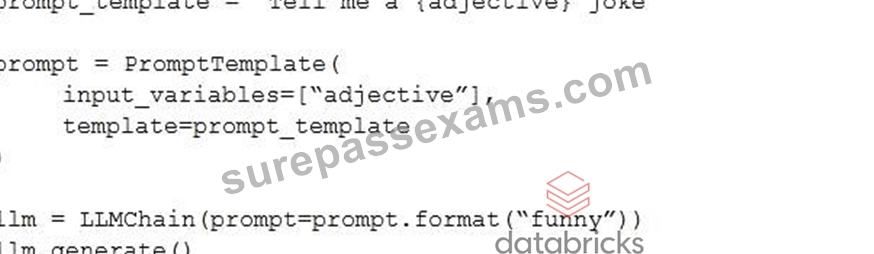
A Generative AI Engineer is testing a simple prompt template in LangChain using the code below, but is getting an error.
Assuming the API key was properly defined, what change does the Generative AI Engineer need to make to fix their chain?
- A.

- B.

- C.

- D.
Answer: A
Explanation:
To fix the error in the LangChain code provided for using a simple prompt template, the correct approach is Option C. Here's a detailed breakdown of why Option C is the right choice and how it addresses the issue:
* Proper Initialization: In Option C, the LLMChain is correctly initialized with the LLM instance specified as OpenAI(), which likely represents a language model (like GPT) from OpenAI. This is crucial as it specifies which model to use for generating responses.
* Correct Use of Classes and Methods:
* The PromptTemplate is defined with the correct format, specifying that adjective is a variable within the template. This allows dynamic insertion of values into the template when generating text.
* The prompt variable is properly linked with the PromptTemplate, and the final template string is passed correctly.
* The LLMChain correctly references the prompt and the initialized OpenAI() instance, ensuring that the template and the model are properly linked for generating output.
Why Other Options Are Incorrect:
* Option A: Misuses the parameter passing in generate method by incorrectly structuring the dictionary.
* Option B: Incorrectly uses prompt.format method which does not exist in the context of LLMChain and PromptTemplate configuration, resulting in potential errors.
* Option D: Incorrect order and setup in the initialization parameters for LLMChain, which would likely lead to a failure in recognizing the correct configuration for prompt and LLM usage.
Thus, Option C is correct because it ensures that the LangChain components are correctly set up and integrated, adhering to proper syntax and logical flow required by LangChain's architecture. This setup avoids common pitfalls such as type errors or method misuses, which are evident in other options.
NEW QUESTION # 34
A Generative AI Engineer is developing a patient-facing healthcare-focused chatbot. If the patient's question is not a medical emergency, the chatbot should solicit more information from the patient to pass to the doctor' s office and suggest a few relevant pre-approved medical articles for reading. If the patient's question is urgent, direct the patient to calling their local emergency services.
Given the following user input:
"I have been experiencing severe headaches and dizziness for the past two days." Which response is most appropriate for the chatbot to generate?
- A. Please provide your age, recent activities, and any other symptoms you have noticed along with your headaches and dizziness.
- B. Here are a few relevant articles for your browsing. Let me know if you have questions after reading them.
- C. Headaches can be tough. Hope you feel better soon!
- D. Please call your local emergency services.
Answer: D
Explanation:
* Problem Context: The task is to design responses for a healthcare-focused chatbot that appropriately addresses the urgency of a patient's symptoms.
* Explanation of Options:
* Option A: Suggesting articles might be suitable for less urgent inquiries but is inappropriate for symptoms that could indicate a serious condition.
* Option B: Given the description of severe symptoms like headaches and dizziness, directing the patient to emergency services is prudent. This aligns with medical guidelines that recommend immediate professional attention for such severe symptoms.
* Option C: Offering well-wishes does not address the potential seriousness of the symptoms and lacks appropriate action.
* Option D: While gathering more information is part of a detailed assessment, the immediate need here suggests a more urgent response.
Given the potential severity of the described symptoms,Option Bis the most appropriate, ensuring the chatbot directs patients to seek urgent care when needed, potentially saving lives.
NEW QUESTION # 35
A Generative AI Engineer is designing an LLM-powered live sports commentary platform. The platform provides real-time updates and LLM-generated analyses for any users who would like to have live summaries, rather than reading a series of potentially outdated news articles.
Which tool below will give the platform access to real-time data for generating game analyses based on the latest game scores?
- A. AutoML
- B. DatabrickslQ
- C. Feature Serving
- D. Foundation Model APIs
Answer: C
Explanation:
* Problem Context: The engineer is developing an LLM-powered live sports commentary platform that needs to provide real-time updates and analyses based on the latest game scores. The critical requirement here is the capability to access and integrate real-time data efficiently with the platform for immediate analysis and reporting.
* Explanation of Options:
* Option A: DatabricksIQ: While DatabricksIQ offers integration and data processing capabilities, it is more aligned with data analytics rather than real-time feature serving, which is crucial for immediate updates necessary in a live sports commentary context.
* Option B: Foundation Model APIs: These APIs facilitate interactions with pre-trained models and could be part of the solution, but on their own, they do not provide mechanisms to access real- time game scores.
* Option C: Feature Serving: This is the correct answer as feature serving specifically refers to the real-time provision of data (features) to models for prediction. This would be essential for an LLM that generates analyses based on live game data, ensuring that the commentary is current and based on the latest events in the sport.
* Option D: AutoML: This tool automates the process of applying machine learning models to real-world problems, but it does not directly provide real-time data access, which is a critical requirement for the platform.
Thus,Option C(Feature Serving) is the most suitable tool for the platform as it directly supports the real-time data needs of an LLM-powered sports commentary system, ensuring that the analyses and updates are based on the latest available information.
NEW QUESTION # 36
Generative AI Engineer at an electronics company just deployed a RAG application for customers to ask questions about products that the company carries. However, they received feedback that the RAG response often returns information about an irrelevant product.
What can the engineer do to improve the relevance of the RAG's response?
- A. Assess the quality of the retrieved context
- B. Use a different semantic similarity search algorithm
- C. Implement caching for frequently asked questions
- D. Use a different LLM to improve the generated response
Answer: A
Explanation:
In a Retrieval-Augmented Generation (RAG) system, the key to providing relevant responses lies in the quality of the retrieved context. Here's why option A is the most appropriate solution:
* Context Relevance:The RAG model generates answers based on retrieved documents or context. If the retrieved information is about an irrelevant product, it suggests that the retrieval step is failing to select the right context. The Generative AI Engineer must first assess the quality of what is being retrieved and ensure it is pertinent to the query.
* Vector Search and Embedding Similarity:RAG typically uses vector search for retrieval, where embeddings of the query are matched against embeddings of product descriptions. Assessing the semantic similarity searchprocess ensures that the closest matches are actually relevant to the query.
* Fine-tuning the Retrieval Process:By improving theretrieval quality, such as tuning the embeddings or adjusting the retrieval strategy, the system can return more accurate and relevant product information.
* Why Other Options Are Less Suitable:
* B (Caching FAQs): Caching can speed up responses for frequently asked questions but won't improve the relevance of the retrieved content for less frequent or new queries.
* C (Use a Different LLM): Changing the LLM only affects the generation step, not the retrieval process, which is the core issue here.
* D (Different Semantic Search Algorithm): This could help, but the first step is to evaluate the current retrieval context before replacing the search algorithm.
Therefore, improving and assessing the quality of the retrieved context (option A) is the first step to fixing the issue of irrelevant product information.
NEW QUESTION # 37
A Generative Al Engineer is developing a RAG application and would like to experiment with different embedding models to improve the application performance.
Which strategy for picking an embedding model should they choose?
- A. Pick the most recent and most performant open LLM released at the time
- B. Pick an embedding model trained on related domain knowledge
- C. Pick an embedding model with multilingual support to support potential multilingual user questions
- D. pick the embedding model ranked highest on the Massive Text Embedding Benchmark (MTEB) leaderboard hosted by HuggingFace
Answer: B
Explanation:
The task involves improving a Retrieval-Augmented Generation (RAG) application's performance by experimenting with embedding models. The choice of embedding model impacts retrieval accuracy,which is critical for RAG systems. Let's evaluate the options based on Databricks Generative AI Engineer best practices.
* Option A: Pick an embedding model trained on related domain knowledge
* Embedding models trained on domain-specific data (e.g., industry-specific corpora) produce vectors that better capture the semantics of the application's context, improving retrieval relevance. For RAG, this is a key strategy to enhance performance.
* Databricks Reference:"For optimal retrieval in RAG systems, select embedding models aligned with the domain of your data"("Building LLM Applications with Databricks," 2023).
* Option B: Pick the most recent and most performant open LLM released at the time
* LLMs are not embedding models; they generate text, not embeddings for retrieval. While recent LLMs may be performant for generation, this doesn't address the embedding step in RAG. This option misunderstands the component being selected.
* Databricks Reference: Embedding models and LLMs are distinct in RAG workflows:
"Embedding models convert text to vectors, while LLMs generate responses"("Generative AI Cookbook").
* Option C: Pick the embedding model ranked highest on the Massive Text Embedding Benchmark (MTEB) leaderboard hosted by HuggingFace
* The MTEB leaderboard ranks models across general tasks, but high overall performance doesn't guarantee suitability for a specific domain. A top-ranked model might excel in generic contexts but underperform on the engineer's unique data.
* Databricks Reference: General performance is less critical than domain fit:"Benchmark rankings provide a starting point, but domain-specific evaluation is recommended"("Databricks Generative AI Engineer Guide").
* Option D: Pick an embedding model with multilingual support to support potential multilingual user questions
* Multilingual support is useful only if the application explicitly requires it. Without evidence of multilingual needs, this adds complexity without guaranteed performance gains for the current use case.
* Databricks Reference:"Choose features like multilingual support based on application requirements"("Building LLM-Powered Applications").
Conclusion: Option A is the best strategy because it prioritizes domain relevance, directly improving retrieval accuracy in a RAG system-aligning with Databricks' emphasis on tailoring models to specific use cases.
NEW QUESTION # 38
After changing the response generating LLM in a RAG pipeline from GPT-4 to a model with a shorter context length that the company self-hosts, the Generative AI Engineer is getting the following error:
What TWO solutions should the Generative AI Engineer implement without changing the response generating model? (Choose two.)
- A. Retrain the response generating model using ALiBi
- B. Decrease the chunk size of embedded documents
- C. Reduce the number of records retrieved from the vector database
- D. Reduce the maximum output tokens of the new model
- E. Use a smaller embedding model to generate
Answer: B,C
Explanation:
* Problem Context: After switching to a model with a shorter context length, the error message indicating that the prompt token count has exceeded the limit suggests that the input to the model is too large.
* Explanation of Options:
* Option A: Use a smaller embedding model to generate- This wouldn't necessarily address the issue of prompt size exceeding the model's token limit.
* Option B: Reduce the maximum output tokens of the new model- This option affects the output length, not the size of the input being too large.
* Option C: Decrease the chunk size of embedded documents- This would help reduce the size of each document chunk fed into the model, ensuring that the input remains within the model's context length limitations.
* Option D: Reduce the number of records retrieved from the vector database- By retrieving fewer records, the total input size to the model can be managed more effectively, keeping it within the allowable token limits.
* Option E: Retrain the response generating model using ALiBi- Retraining the model is contrary to the stipulation not to change the response generating model.
OptionsCandDare the most effective solutions to manage the model's shorter context length without changing the model itself, by adjusting the input size both in terms of individual document size and total documents retrieved.
NEW QUESTION # 39
A Generative AI Engineer is developing an LLM application that users can use to generate personalized birthday poems based on their names.
Which technique would be most effective in safeguarding the application, given the potential for malicious user inputs?
- A. Reduce the time that the users can interact with the LLM
- B. Ask the LLM to remind the user that the input is malicious but continue the conversation with the user
- C. Implement a safety filter that detects any harmful inputs and ask the LLM to respond that it is unable to assist
- D. Increase the amount of compute that powers the LLM to process input faster
Answer: C
Explanation:
In this case, the Generative AI Engineer is developing an application to generate personalized birthday poems, but there's a need to safeguard againstmalicious user inputs. The best solution is to implement asafety filter (option A) to detect harmful or inappropriate inputs.
* Safety Filter Implementation:Safety filters are essential for screening user input and preventing inappropriate content from being processed by the LLM. These filters can scan inputs for harmful language, offensive terms, or malicious content and intervene before the prompt is passed to the LLM.
* Graceful Handling of Harmful Inputs:Once the safety filter detects harmful content, the system can provide a message to the user, such as "I'm unable to assist with this request," instead of processing or responding to malicious input. This protects the system from generating harmful content and ensures a controlled interaction environment.
* Why Other Options Are Less Suitable:
* B (Reduce Interaction Time): Reducing the interaction time won't prevent malicious inputs from being entered.
* C (Continue the Conversation): While it's possible to acknowledge malicious input, it is not safe to continue the conversation with harmful content. This could lead to legal or reputational risks.
* D (Increase Compute Power): Adding more compute doesn't address the issue of harmful content and would only speed up processing without resolving safety concerns.
Therefore, implementing asafety filterthat blocks harmful inputs is the most effective technique for safeguarding the application.
NEW QUESTION # 40
......
Certification Topics of Databricks-Generative-AI-Engineer-Associate Exam PDF Recently Updated Questions: https://dumpsninja.surepassexams.com/Databricks-Generative-AI-Engineer-Associate-exam-bootcamp.html